
“We do not come to communities saying: ‘We know what you need.’ Instead, we ask: ‘What is important to you? What do you want to change? What can you do together, and how can we support you to achieve it?”
“ACA will facilitate, the Assembly will support, our partners will contribute, but the communities must lead. This is how we move from dependency to ownership.”
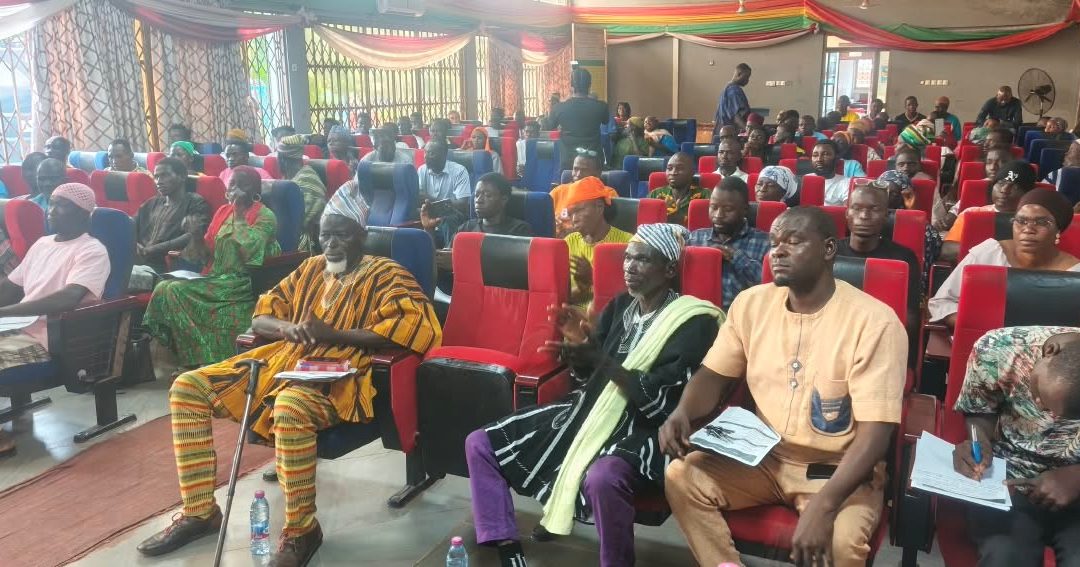
These words from ACA’s Director of Community-Driven Development (CDD), Nana Ama Nketia-Quaidoo set the tone for the official launch of a partnership aimed at strengthening community agency, improving access to water, sanitation and hygiene (WASH), enhancing livelihoods and deepening government accountability has been launched in the West Mamprusi Municipality of the North East Region.
Known locally as Ting Labginsim, the Advancing Community Agency and Government Accountability for WASH and Livelihood Improvement Project is a partnership between Advocates for Community Alternatives (ACA), Spark MicroGrants, Water and Sanitation for the Urban Poor (WSUP) and the West Mamprusi Municipal Assembly.
The two-year initiative will work with 100 communities across the municipality, giving residents the opportunity to identify their development priorities, mobilise local resources and work collectively towards addressing challenges affecting their communities.
Speaking at the launch in Walewale, ACA’s CDD Director, Nana Ama Nketia-Quaidoo, said the project was anchored on the belief that communities possessed the knowledge, ideas and capacity to address many of their own development challenges when provided with the necessary information, facilitation and resources. 
ACA’s CDD Director, Nana Ama Nketia-Quaidoo, speaking at the event
She explained that the project would employ ACA’s Facilitated Collective Action Process (FCAP), a community-driven approach which asks residents to determine what was important to them, what they wanted to change and what they could achieve together.
According to her, the process would be implemented in three phases: community building and visioning; implementation and advocacy; and post-implementation.
The approach, she said, had already produced significant results in 107 communities in Fanteakwa South, Nkoranza South, Abuakwa South and Atiwa West, where communities had implemented projects including clinics, schools, laboratories, markets, boreholes, poultry and palm-oil processing centres, milling and soap-making facilities, teachers’ and nurses’ bungalows and community centres.
Under Ting Labginsim, each of the 100 communities will receive an US$8,000 microgrant, amounting to US$800,000 in total, while the West Mamprusi Municipal Assembly will contribute US$400 per community, representing a total counterpart contribution of US$40,000.
The financial commitment by the Assembly is expected to reinforce local ownership and ensure that the initiative is integrated into the municipality’s broader development efforts.
Nana Ama stressed that the partnership was about more than financial resources. Communities would be expected to contribute their ideas, time, labour and local resources, while the Assembly would provide technical support, monitoring, coordination and linkages between community priorities and municipal development planning.
The Municipal Assembly is also expected to work closely with relevant departments to provide weekly supervision, encouragement and technical direction to participating communities.
A steering committee, headed by the Municipal Chief Executive (MCE) and comprising relevant partners, has been established to provide oversight of the initiative. The committee is expected to meet quarterly to review progress, address challenges and consider innovations to improve implementation.
For his part, Mohammed Rabiu Jabaah, West Mamprusi Municipal Chief Executive, underscored the importance of community ownership, stressing that the projects should belong to the communities rather than the Assembly or its development partners.

MCE for West Mamprusi, Mohammed Rabiu Jabaah at the launch
He also described the intervention as a significant relief to the Assembly and assured that the Assembly would “religiously” play its part of the bargain.
The commitment of the Assembly is expected to be particularly important in ensuring that community priorities receive the necessary technical and institutional support beyond the provision of funding.
Spark MicroGrants Ghana Country Director, Ann Squire, said the initiative reflected the organisation’s conviction that people closest to a problem were often closest to its solution.
She said Ting Labginsim would strengthen WASH services, build stronger livelihoods and deepen accountability between citizens and government.
She noted that the three objectives were interconnected, explaining that clean water and good hygiene, decent livelihoods and responsive government all contributed to the dignity and wellbeing of families.
WSUP’s technical expertise is expected to complement the community-driven approach, particularly in areas where community priorities intersect with WASH needs.
At the heart of the project, however, are the communities themselves. Residents, including women, young people, persons with special abilities and other groups whose voices may sometimes be excluded from development discussions, are expected to participate actively in planning and implementation.
ACA believes the ultimate success of Ting Labginsim will not simply be measured by the number of projects completed, but by whether communities continue to meet, plan together, mobilise local resources and collectively address their development challenges after external support ends.
The partnership therefore represents a shift from dependency towards ownership, with communities leading the process, ACA providing facilitation, the Municipal Assembly providing institutional and technical support, and development partners contributing funding and expertise.
With the rollout to all 100 communities already underway, Ting Labginsim offers West Mamprusi an opportunity to strengthen the relationship between citizens and local government while demonstrating the potential of community-led development to deliver sustainable improvements in people’s lives.
Commentaires récents