
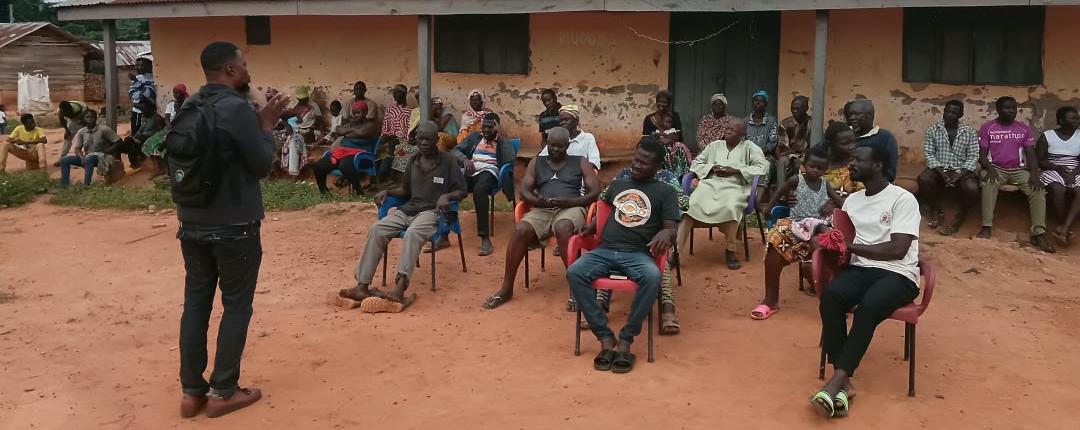
For more than a decade, Bommie Adamu dedicated his professional life to the classroom, teaching and shaping the lives of young people. Today, however, his passion for service has taken him beyond the four walls of the classroom into communities, where he is helping people take charge of their own development.
A trained teacher, Mr Adamu taught for about eleven years, from November 12, 2012, to February 2, 2024, before joining Advocates for Community Alternatives (ACA) as a Community Trainer.
His decision to join ACA was driven by his desire to explore a new working environment and contribute to development in a different but equally meaningful way. After completing the 2023 academic year, during which he taught Integrated Science at the senior high school level, he came across an opportunity to join ACA.
He decided to apply.
That decision has since opened a new chapter in his professional journey, one that has brought him closer to communities and given him a deeper appreciation of the power of collective action.
Inspired by Smiles and Community Success
For Mr Adamu, one of the strongest attractions to ACA’s mission is the visible impact of its work on the lives of ordinary people.
“The smile on the faces of vulnerable community members after they have achieved part of their goals through their chosen development pathway is one of the things that inspires me,” he said.
Through its Community-Driven Development (CDD) approach, ACA supports communities to identify their own development priorities, make collective decisions and take the lead in planning and implementing projects that respond to their needs.
To Mr Adamu, community-driven development means giving communities the opportunity and responsibility to champion their own development.
“It is a situation where communities are given the opportunity to take the lead in decision-making, planning and implementing their own development projects,” he explained.
His work has, however, also exposed him to the complex realities and challenges that come with supporting communities to manage development resources.
Lessons learnt
According to him, one of the major lessons he has learned is the need for continuous engagement, accountability and education, particularly in the management of community grants.
He noted that while many community members are committed to collective development, there are instances where individuals may view project funds as opportunities for personal benefit.
“There are times when some community members want to use the grant for personal gains instead of focusing on the agreed community project,” he observed.
He also pointed to situations where local artisans charge communities more than the prevailing market rates for services, simply because they are aware that a grant has been provided for a project.
“These and many other issues are among the battles we continue to confront in our work with communities,” he said.
Memorable experiences
Among his most memorable experiences at ACA is an incident involving a contractor engaged to drill boreholes for three communities under his supervision – Bepoase, Ehiamenkyene No. 1 and Ahinkwakrom.
According to Mr. Adamu, the contractor allegedly collected money meant for the drilling works and subsequently became difficult to trace.
“He stopped picking calls, and the communities did not know his whereabouts. They did not know where he lived and did not even have a photograph of him,” he recalled.
Fortunately, Mr Adamu had earlier taken a photograph of the contractor after becoming suspicious about his conduct and his apparent disregard for several calls.
That photograph later proved crucial.
“It was the picture I had taken earlier that was eventually used to identify him and help resolve the issue,” he said.
The contractor was eventually traced and brought back on board to carry out the drilling works for the affected communities.
For Mr Adamu, the incident remains his biggest personal achievement since joining ACA.
“It may seem like a simple thing, but taking that picture helped us trace the contractor and ensure that the communities eventually received their water projects,” he said.
The experience, he believes, also demonstrates the importance of vigilance, documentation and close monitoring in community development work.
Celebrating Visible Change
Among the projects that have left a lasting impression on Mr Adamu is the improvement of a section of the road at Nsuta Dahome.
Seeing communities move from identifying their challenges to collectively working towards practical solutions, he said, continues to give him a strong sense of fulfilment.
However, his work has not been without challenges.
One of his most difficult experiences involved a community known as Asedja Dorse, where members selected a development pathway whose estimated cost was more than three times the value of the available microgrant.
Despite advice from technical officers and the Director of Community-Driven Development to reconsider and select a more realistic project within the available resources, the community remained adamant.
Eventually, a decision was taken for the grant to be allocated to a nearby community, Asedja Proper, which was ready to undertake a project within the available funding.
The experience, according to Mr Adamu, reinforced the importance of flexibility, consensus-building and realistic planning in the community development process.
Passion Beyond Community Work
Outside his official responsibilities at ACA, Mr. Adamu has a strong interest in agriculture, particularly crop and animal farming.

He sees agriculture not only as a personal passion but also as an important area with enormous potential to improve livelihoods and promote sustainable development in rural communities.
Looking into the future, Mr Adamu hopes to see ACA expand its work across all 16 regions of Ghana.
His ultimate vision is for the organisation’s community-led development approach, popularly known as the “Oman Yie Die” process, to gain wider recognition and eventually inspire a national approach to development.
“I want to see ACA extend its work to all the 16 regions of Ghana, leading to the Government of Ghana adopting the Oman Yie Die process as an approach to carrying out development across the country,” he said.
From teaching Integrated Science in the classroom to facilitating collective action in communities, Bommie Adamu’s journey reflects a transition from educating individual learners to helping entire communities learn, organise and take ownership of their future.
For him, the greatest reward remains simple: seeing communities overcome challenges, achieve their goals and smile with the satisfaction that the development they are experiencing is one they helped to create themselves.
Commentaires récents