
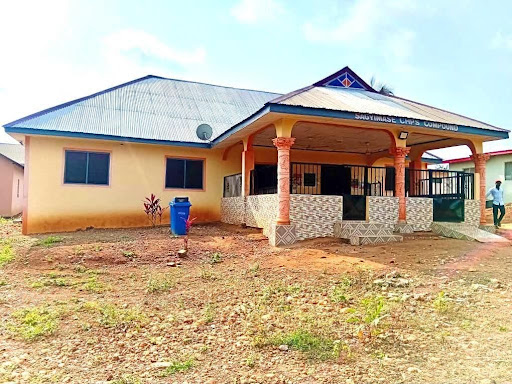
For years, the people of Sagyemase, a community near Kyebi in the Abuakwa South Municipality of Ghana’s Eastern Region, knew exactly what was wrong with their community.
They knew that pregnant women sometimes struggled to reach a health facility when complications arose. They knew that accident victims, particularly motorbike riders, could be left helpless because there was no health facility nearby to provide even basic emergency care. They knew that elderly residents often had to travel to neighbouring communities to seek treatment.
What they did not know was how to come together, organise themselves and turn those concerns into practical solutions.
That began to change when Advocates for Community Alternatives (ACA) entered the community in 2020 to introduce the Facilitated Collective Action Process (FCAP), locally known as “Oman yie die.” This was during the period of COVID-19 pandemic.
Implemented through a collaboration involving ACA, the Abuakwa South Municipal Assembly and the Sagyemase community, FCAP would eventually help residents move from simply identifying their problems to collectively deciding what they could do about them.
And at the centre of that transformation is a CHPS compound that residents say has changed the face of healthcare in Sagyemase.
Before FCAP
Before FCAP, community development discussions were largely the preserve of the chief and his elders. Residents had problems, but there was little structured community-wide effort to identify priorities, mobilise resources and pursue solutions.
According to community members, the lack of support and guidance made it difficult to move from recognising problems to solving them.
The consequences were particularly serious for pregnant women, elderly residents and accident victims.
There were occasions when a first-aid intervention could have made a difference, but the absence of an appropriate health facility meant that patients had to travel long distances for treatment.
For pregnant women, delays in reaching a health facility could become a matter of life and death.
For motorbike accident victims, every minute counted.
The community had tried little to address the situation, largely because, as residents explained, they lacked the organisational support and guidance needed to act.
Then came FCAP
The arrival of ACA provided something Sagyemase had been missing: a structured process for bringing people together to identify their most pressing needs and take collective action.
Initially, residents could not even agree on one particular problem. Different parts of the community had different concerns.
Through meetings and facilitated discussions, however, residents began to understand that they could collectively determine what mattered most and what they were capable of changing.
Community members turned up in large numbers, contributing their time, ideas, labour and, in some cases, money. The chief of the town demonstrated leadership in the entire process by personally taking part in the weekly community meetings and played a key role in raising funds to supplement ACA’s microgrant. He also paid regular visits to the project site to assess the progress of work.
The chief and elders played an important role, while women and young people also participated actively in communal activities.
The community eventually agreed to work hand in hand with ACA towards a common goal.
The chief reinforced the process with community bylaws designed to encourage participation.
Among them was a requirement for residents who failed to participate in communal labour to pay a GH¢100 penalty. Community members were also expected to attend meetings, while each household within Sagyemase was required to send a representative.
It was a significant shift.
The community was no longer waiting for someone else to solve its problems.
It was beginning to take ownership.
ACA’s role: More than a microgrant
ACA’s contribution went beyond providing financial support.
The organisation introduced residents to a series of trainings designed to help them understand community development, identify what they wanted to accomplish and work collectively towards their goals.
A project facilitator was also assigned to guide the community through the process.
For Francis Fenaldinho Manu, who served as the ACA Community Trainer for Sagyemase, the experience was particularly demanding because the project was among the first FCAP interventions in the Eastern Region.
At the time, the Community-Based Facilitator (CBF) system had not yet been established. This meant that he had to personally mobilize residents for meetings and remain closely involved throughout implementation to ensure that activities stayed on course.
Yet he recalls that the commitment of the community, particularly the leadership of the chief, helped make the project possible and provided lessons that other communities could learn from.
The healthcare crisis that could no longer be ignored
Before the CHPS compound, healthcare workers operated under difficult conditions.
Linda Ansah, a nurse who has worked in Sagyemase for more than five years, remembers when the health facility operated from a classroom.
“There was no proper ward where patients could be detained or observed. Even though some equipment were available, the lack of space made treatment difficult and stressful,” she recounts.
The situation also affected staffing. According to her, the inadequate facility contributed to difficulties in attracting and retaining a midwife, while the number of patients that could be treated was limited.
For residents, emergencies were even more frightening.
Matilda Asante, a community member who was very instrumental in the implementation of the project also recalls an accident in which the victim was bleeding heavily and drivers were reluctant to transport the person to hospital.
For Yaw Frank, a committee member who speaks particularly for young people and motorbike riders, the delay in getting accident victims to hospital could mean the difference between life and death.
The problem was not confined to one group.
Elderly people, pregnant women and accident victims were among those most affected, while the wider community also bore the consequences.
A new chapter
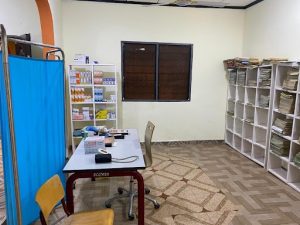
Today, the story is remarkably different. The completion of the CHPS compound has provided Sagyemase with a more suitable environment for healthcare delivery.
For Nurse Linda, the transformation is clear.
The community now has a midwife, while patients’ numbers have increased significantly. The facility can sometimes attend to between 15 and 20 patients a day or more, she says.
More importantly, the facility provides an environment where health workers can administer first aid to emergency patients before arranging transfers to hospital when necessary.
For residents who once faced the anxiety of transporting sick relatives late at night, the presence of the CHPS compound has brought a new sense of security.
Madam Olivia Amoakoa Yeboah, an FCAP member, says the facility has made a major difference, particularly for people who fall ill at odd hours and would previously have struggled to find transportation to a hospital.
And the benefits are not limited to statistics.
They are personal.
“My mother could have died that day”
For Matilda, the value of the project became painfully real when her own mother visited her.
About a month and two weeks before the interview, her mother suddenly became unwell and was taken to the CHPS compound.
Upon arrival, she became unconscious.
The family needed to find a vehicle to transport her to hospital, but while they were searching for one, the nurses at the CHPS compound attended to her.
By the time transportation was found, her mother had regained consciousness.
For Matilda, that moment captured exactly what the project meant to the community.
Without the CHPS facility and the nurses who attended to her mother while they searched for transport, she believes the outcome could have been tragic.
That is the kind of transformation that is difficult to measure simply by counting patients.
It is measured in minutes gained during an emergency.
In pregnancies that can now be managed closer to home.
In elderly people who no longer have to begin every medical emergency with a long journey.
And in families who have a better chance of getting help when they need it most.
A project the community now owns
The people of Sagyemase do not see the CHPS compound simply as a project delivered to them.
They see it as something they helped create.
That sense of ownership is reflected in the systems they have put in place to sustain it.
The community has introduced a GH¢5 contribution for patients who visit the facility for healthcare, with proceeds intended to support maintenance.
A group of community leaders drawn from the Christian community, traditional leadership and the FCAP group has also been selected to oversee the maintenance of the project.
The community is also constructing accommodation for nurses. The building is currently at the lintel stage.
Expectations
Nurse Linda says the facility needs additional equipment to improve its operations.
It is the expectation of Olivia that the community will be able to secure accommodation for nurses, even without ACA’s intervention, noting that some health workers travel from far distances to work at the facility.
For Frank, security is also important because some community members use the facility as a playground after closing hours.
Lessons
Sagyemase has learned that it can act.
For the community, the most important lesson from FCAP may not be the CHPS compound itself.
It is the power of collective action.
Residents say they have learned that when people come together with a common purpose, they can achieve things that once appeared beyond their reach.
They have also learned the importance of leadership.
The role played by the chief and other community leaders demonstrated that strong leadership can help mobilise people around a shared objective.
And perhaps most importantly, they have learned that development does not end when a project is completed.
It begins a new phase.
The community must maintain what it has built and ensure that it serves future generations.
From a community that could not agree on one problem to a community that knows it can solve problems
Sagyemase’s journey is therefore bigger than the construction of a CHPS compound.
It is a story about a community discovering its own capacity.
Before FCAP, residents knew their problems but struggled to organise around solutions.
Today, they have a functioning health facility, a midwife, improved space for healthcare delivery and a community structure committed to sustaining the gains.
The transformation has also changed the community’s aspirations.
Residents say that when they look back at the challenges they once faced and compare them with where they are today, they are increasingly convinced that whatever they collectively set their minds to achieve is possible.
That may ultimately be the most enduring legacy of FCAP in Sagyemase:
The community did not simply receive a CHPS compound. It discovered the power to shape its own future.
FCAP started in sagyimase during the Covid in August 2020.
Also it wasn’t a partnership with Spark.
Kindly also highlight the important role their chief played in the process. He took part in weekly meetings and at implementation sites and fundraising
Recent Comments