
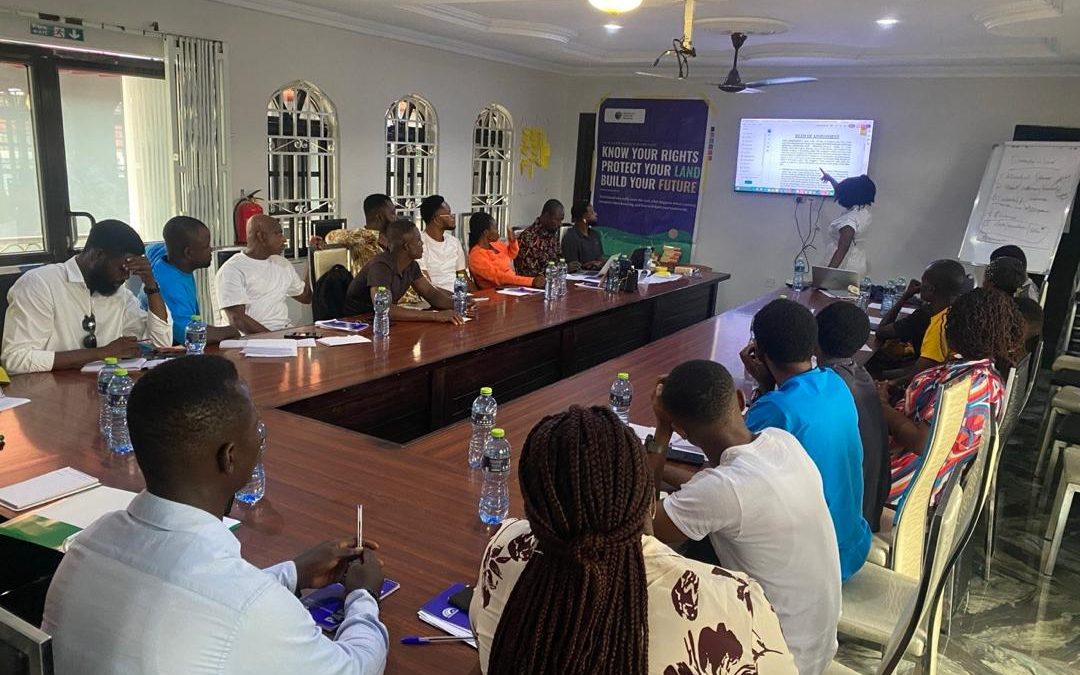
What happens when a mining company arrives on your land? Who owns the minerals beneath it? What are your rights when your land, crops, buildings or business are affected?
These and other important questions took centre stage when Advocates for Community Alternatives (ACA) organised a land and mining rights training programme for community representatives in Nkoranza in the Bono East Region.
The training, facilitated by ACA Legal Officer, Bridget Kartey, was designed to equip community members with practical knowledge to understand, protect and assert their rights in relation to land ownership, mining activities and land acquisition.
The training covered land ownership and documentation, including allodial and usufructuary interests, leaseholds, customary tenancies, land searches and land registration.
Particular attention was given to what communities should expect when mining companies seek to acquire or use their land, from notification and consultation to compensation and avenues for seeking redress.
The facilitator explained the different forms of loss for which compensation may arise when properties are destroyed as a result of mining activities.
The training further explored Ghana’s mining laws and the rights and obligations of mineral-right holders, as well as issues surrounding small-scale mining and sand winning.
On environmental protection, participants discussed the effects of dust, noise and vibration, water pollution, waste management and the restoration and reclamation of mined lands.
Participants were encouraged to use photographs and videos, written statements, witness accounts, environmental samples and, where necessary, medical records to build evidence when their rights or environment are affected.
They were also introduced to institutions and organisations where they can seek assistance, including the District Assembly, Minerals Commission, Lands Commission, Environmental Protection Agency (EPA), the courts, Legal Aid Commission, ACA and environmental NGOs.
Concerns about land grabbing and inadequate land documentation were among issues raised by participants, with the facilitator providing guidance on how communities can better protect their interests.
The training ultimately sought to move communities beyond awareness of their rights towards the practical ability to understand, assert and defend those rights.
For ACA, empowering communities with knowledge is an important step towards enabling them to engage mining and other land-related activities from a position of greater understanding, confidence and collective action.
Recent Comments