
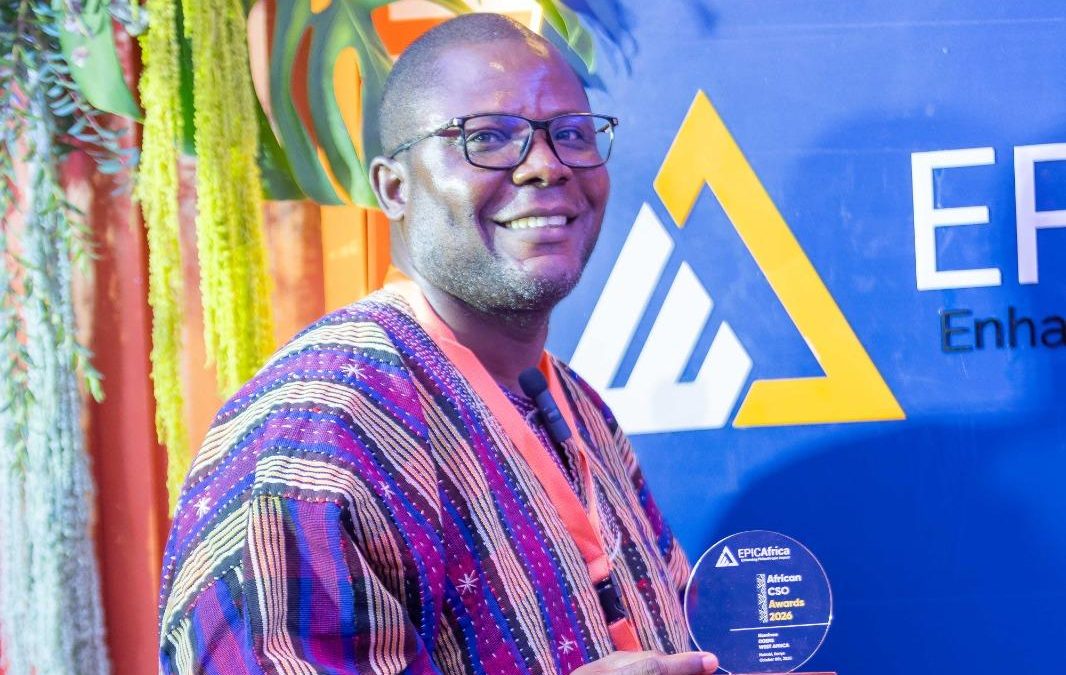
As part of our efforts to stay connected with members of our flagship programme, the Sora Kaufman Fellowship, we caught up with Richmond Amada-Smith, a member of Cohort 2, and asked him a series of questions about his experience and the programme’s impact on his professional journey. To give readers a full appreciation of the interview, we have reproduced his responses to all our questions verbatim. Enjoy reading!
- Personal Journey
Could you briefly tell us about your professional background and what motivated you to apply for the Sora Kaufman Fellowship Programme?
My name is Richmond Amada-Smith, and I am the Project Director of Heritage Charity Foundation (HCF), a nonprofit organization founded in the year 2014 and working in water and sanitation, education, women’s economic empowerment, environmental conservation, and sustainable livelihoods. My experience working with underserved rural communities has exposed me to persistent challenges of poverty, inequality, and environmental degradation. I applied for the Sora Kaufman Fellowship to strengthen my leadership, systems thinking, and problem-solving skills, while learning innovative approaches to community-led development and sustainable social transformation.
- Expectations Versus Reality
What were your expectations when you joined Cohort 2, and to what extent has the Fellowship met or exceeded those expectations?
I expected to acquire practical leadership skills, deepen my understanding of systemic development challenges, and connect with like-minded colleague changemakers. The Fellowship has been valuable in encouraging critical reflection, strategic thinking, and more inclusive approaches to development. It has broadened my perspective beyond implementing individual projects to understanding the interconnected systems influencing community challenges and identifying more sustainable solutions.
- Skills and Knowledge Acquired
What specific skills, knowledge or professional competencies have you acquired through the Fellowship?
The Fellowship has strengthened my understanding of community-driven development approach, local resource mobilization, stakeholder mapping, stakeholder engagement, and strategic problem-solving. I have developed a greater appreciation of how social, economic, environmental, and institutional factors interact to influence development outcomes. These competencies have strengthened my approach to project design, community participation, organizational decision-making, and long-term sustainability, enabling me to consider wider structural challenges rather than focusing exclusively on immediate needs.
- Practical Application
Can you share a specific example of how you have applied the knowledge or skills gained through the Fellowship?
A practical example is HCF’s rural water improvement initiative in the Bono Region, where our assessment identified 226 nonfunctional hand-pump boreholes across ten districts. Applying a systems-thinking perspective, we developed a proposed pilot covering 20 communities, involving the rehabilitation of 20 boreholes and construction of 10 new water facilities. Beyond infrastructure, the strategy incorporates community water management, maintenance financing, hygiene education, and youth technical training. This reflects a shift towards addressing the underlying causes of recurring water system failures.
- Career Development
In what ways has the Fellowship influenced your professional growth, career direction or approach to your work?
The Fellowship has strengthened my transition from traditional development approach towards becoming a community-driven development approach, and community-centered leader. It has encouraged me to approach challenges through evidence-based analysis, inclusive decision-making, and long-term institutional sustainability. I am increasingly focused on strengthening HCF’s organizational capacity, developing partnerships, empowering emerging leaders, and promoting community ownership. These lessons are shaping my ambition to contribute more significantly to Ghana’s civil society leadership and sustainable development.
- Networking and Collaboration
How has being part of the Fellowship expanded your professional network, and have meaningful opportunities emerged?
The Fellowship has provided an opportunity to engage with a wider learning community of development practitioners committed to social justice and grassroots transformation. It has reinforced the importance of peer learning, knowledge exchange, and strategic partnerships. Alongside this experience, HCF’s recognition at the 2026 EPIC-Africa African CSO Excellence Awards created opportunities to connect with leaders from EPIC-Africa, Tostan, and other international organizations. I hope to build on these relationships and my Fellowship network to strengthen collaboration, institutional learning, and community development.
- Mindset and Leadership
Has the Fellowship changed how you approach problem-solving, leadership, community engagement or challenges?
Yes. The Fellowship has reinforced my belief that sustainable solutions require understanding the underlying causes of challenges rather than addressing symptoms alone. I now place greater emphasis on systems thinking, listening to community perspectives, and examining how different factors influence development outcomes. It has also strengthened my commitment to participatory leadership, where community members are active decision-makers rather than passive beneficiaries. I increasingly approach leadership through reflection, collaboration, accountability, and a willingness to adapt existing practices.
- Measurable Impact
What achievement or improvement best demonstrates the Fellowship’s positive impact on your work?
A significant milestone in my recent professional journey is HCF’s recognition at the 2026 EPIC-Africa African CSO Excellence Awards in the Doers Category. This award acknowledges my organization’s longstanding commitment to grassroots development. Although it reflects years of collective work rather than a direct outcome of the Fellowship, the recognition coincides with an important period of my leadership development. A more direct application of my learning is our integrated response to the 226 nonfunctional boreholes identified in Bono Region, where our proposed intervention addresses technical, financial, governance, and sustainability challenges together.
- Challenges and Lessons
What has been the most challenging aspect of the Fellowship, and what important lesson have you learnt?
One of the greatest challenges has been balancing my demanding responsibilities as Project Director with the commitment required for meaningful learning and reflection. Another has been critically examining established approaches to community development and remaining open to alternative perspectives. My most important lesson is that effective leadership requires humility, continuous learning, and the courage to question assumptions. I have learned that lasting development outcomes depend on understanding interconnected challenges, engaging communities meaningfully, and designing solutions that remain effective beyond individual project cycles.
- Looking Ahead
How do you intend to use the knowledge, skills and connections gained to advance your career, organisation, community, and ACA’s work?
I intend to integrate community-driven development approach, inclusive leadership, and participatory approaches more deeply into HCF’s programmes, particularly in water governance, women’s economic empowerment, environmental conservation, and sustainable agriculture. I also plan to share Fellowship lessons with colleagues, volunteers, and emerging community leaders through internal learning and mentorship. Furthermore, I hope to maintain active engagement with ACA and fellow Cohort 2 participants, contribute grassroots perspectives to knowledge-sharing opportunities, and explore partnerships that advance community rights and sustainable development.
- Message to ACA
What would you tell ACA and the people behind the Sora Kaufman Fellowship about the difference this opportunity has made?
I sincerely appreciate the entire ACA team and everyone supporting the SK Fellowship for investing in grassroots leadership. This opportunity has strengthened my strategic thinking, encouraged critical self-reflection, and reinforced my commitment to community-driven development. It has reminded me that leadership is not simply about delivering projects but empowering communities to shape their own futures. By investing in practitioners like me, ACA is contributing to stronger local organizations and creating opportunities for lasting community impact. I am grateful to be part of Cohort 2.
- Additional Information
Is there anything else you would like to share?
My Fellowship experience comes at a particularly meaningful stage in my professional journey, following years of working with vulnerable communities and HCF’s recent recognition at the 2026 EPIC-Africa African CSO Excellence Awards in the Doers Category. These experiences have strengthened my determination to build an organization that combines grassroots action, effective leadership, and sustainable development. I encourage emerging African civil society leaders to embrace continuous learning, collaboration, and innovation. For me, true leadership success is measured not by awards or positions, but by the lasting positive changes we create in people’s lives.
Recent Comments